The role of hydrogen offtaker regulation in highly renewable electricity systems

Abstract
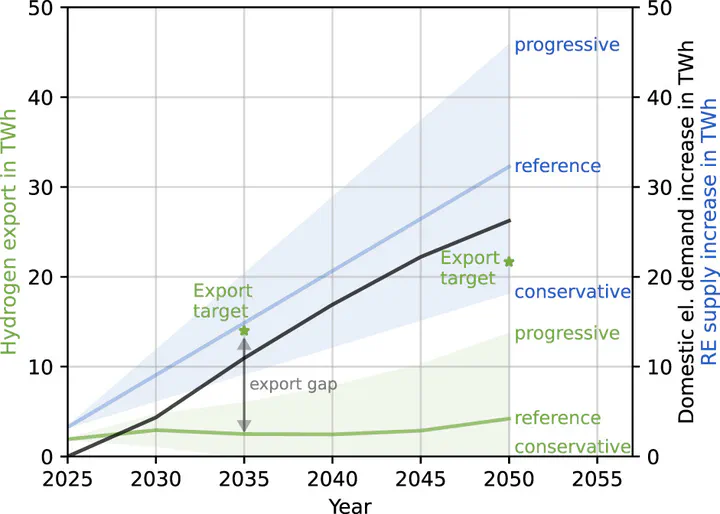
The growing demand for green hydrogen necessitates a rapid scale-up of production and exports to meet decarbonization targets globally. However, current ramp-up efforts remain insufficient, calling for policies that unlock the potential of hydrogen as a low-carbon energy carrier. A key lever is the offtaker regulation, which impacts the pace and sustainability of export projects. This study investigates minimum renewable share requirements for hydrogen exports in countries with high renewable electricity shares. Using New Zealand as a case study, we develop a fully sector-coupled capacity expansion and dispatch model, integrating hydrogen and electricity network planning based on PyPSA-Earth. The model optimizes New Zealand’s energy system under varying export scenarios, renewable electricity shares, and resulting system impacts. We find that domestic electricity demand and renewable expansion rates dominate long-term outcomes, while progressive regulation enables short-term hydrogen and Power-to-X exports. Relaxing the renewable threshold from 80% to 60% triples export volumes from 2.5 TWh to 8.2 TWh by 2030. We propose a two-stage requirement; an initially progressive threshold to attract investment with low consequential emissions, followed by stricter regulation to prevent high emissions, rising domestic electricity prices, and declining hydrogen competitiveness. This framework, demonstrated for New Zealand, can guide hydrogen-exporting countries worldwide.
Type
Publication
Energy
